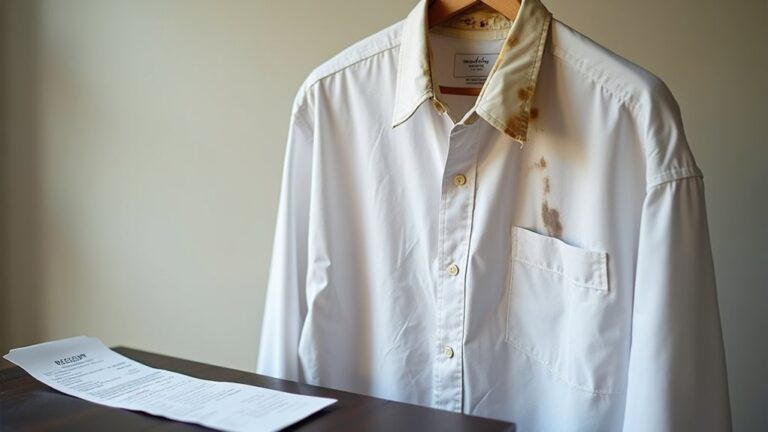
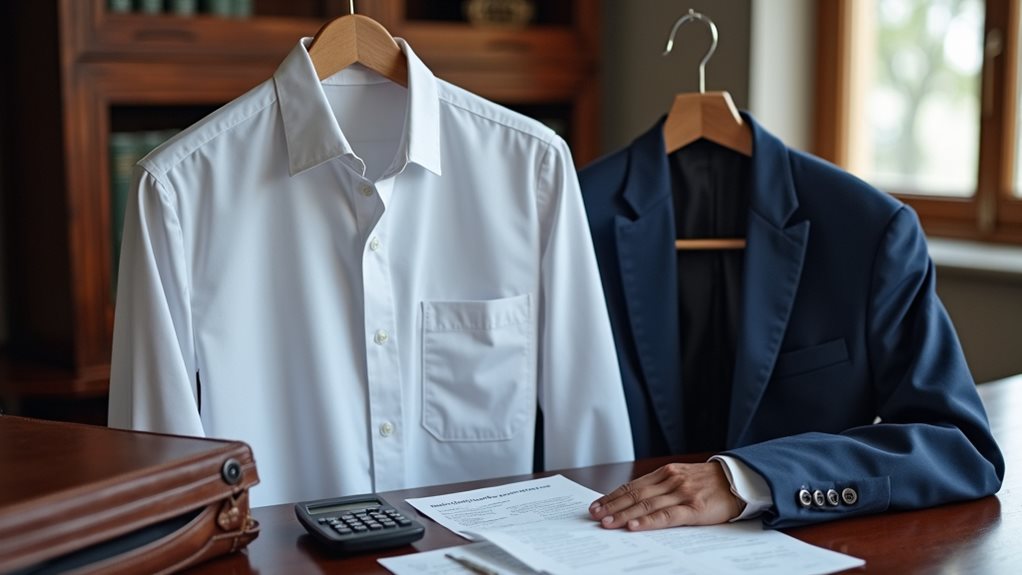

You can deduct dry cleaning costs, but it’s gotten complicated since 2017’s tax changes. If you’re self-employed, you’re in luck—specialized work clothing and uniforms still qualify for deductions. However, if you’re an employee, federal deductions are suspended until 2026, though some states might still allow them. Your clothing must be employer-required, unsuitable for everyday wear, and work-exclusive to qualify. There’s more nuance to traverse depending on your specific situation.
Understanding IRS Requirements for Clothing Deductions
When I first started my consulting business, I’ll admit I thought I could deduct every single dry cleaning bill since those crisp shirts and pressed pants were clearly for work.
But the IRS has some pretty specific rules that crushed my optimistic assumptions about clothing deductions.
Here’s what you need to know: the IRS requires your work clothing to meet three strict criteria before any clothing expenses become deductible.
First, your employer must require the clothing.
Second, it can’t be suitable for everyday wear.
And third, you must wear it exclusively for work purposes.
Unfortunately, most business attire fails this test because it’s considered ordinary street wear.
Even if you’re self-employed, your dry cleaning expenses only qualify when the clothing is necessary for employment and inappropriate for general use, plus you’ll need proper documentation.
However, there are exceptions for specialized uniforms with company logos, protective gear, or costumes required for performers that cannot be worn outside of work.

WOMEN'S CHEF PANTS BUILT FOR REAL KITCHEN WORK – These durable chef pants for women are designed for restaurant, catering, and culinary school kitchens, so you get reliable, professional-grade workwear that holds up shift after shift.

WOMEN'S CHEF PANTS BUILT FOR REAL KITCHEN WORK – These durable chef pants for women are designed for restaurant, catering, and culinary school kitchens, so you get reliable, professional-grade workwear that holds up shift after shift.

3 divided pockets for holding books, pens, money, tools.
Current Federal Tax Law Changes for Employee Deductions
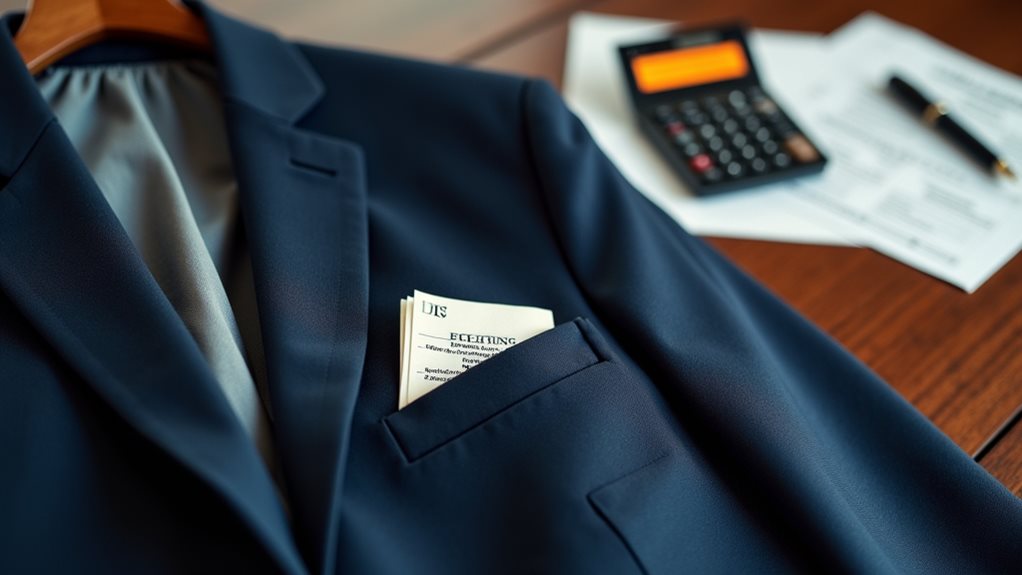
Although I thought the 2017 Tax Cuts and Jobs Act would only shake up corporate taxes, it completely eliminated my ability to deduct dry cleaning costs as an employee, and honestly, this change caught most working professionals off guard.
Federal tax law suspended employee deductions for specialized clothing and employee uniforms until at least 2026, which means you can’t claim that tax deduction anymore, even if your work clothes meet strict IRS criteria.
Federal tax law eliminated employee deductions for work clothing through 2026, regardless of whether your attire meets IRS requirements.
However, if you’re self-employed, you’re still golden – you can deduct dry cleaning expenses for qualifying work attire that isn’t suitable for everyday wear.
Here’s the silver lining: some states haven’t conformed to federal changes, so check your state tax returns for potential deductions on business attire maintenance.
Even without receipts for expenses under $75, you should maintain detailed logs showing the business purpose, date, and amount to support your claims, as the burden of proof remains on you to demonstrate the legitimate business nature of the expense during an audit.
Qualifying Criteria for Work-Related Clothing Expenses
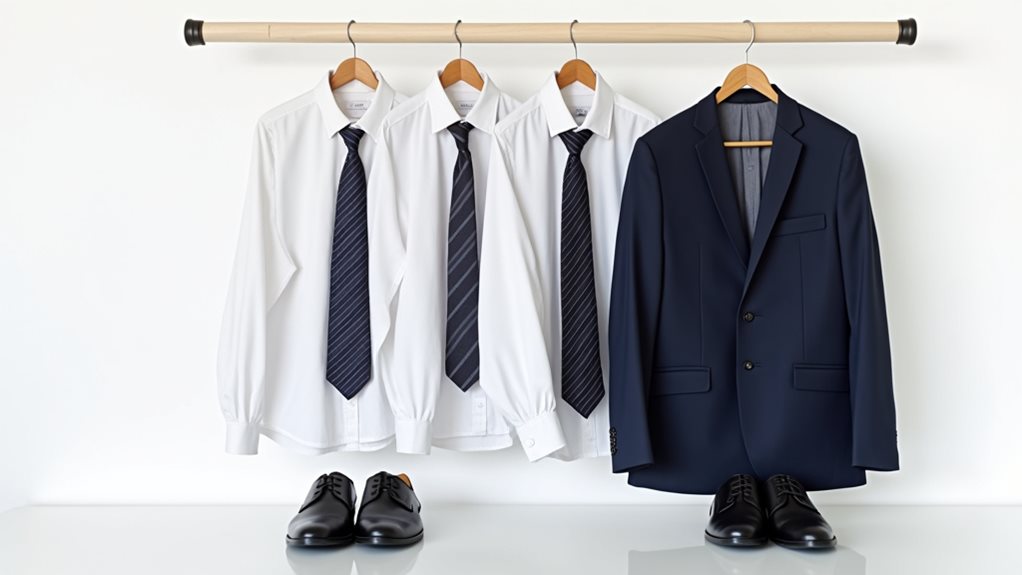
Since I’ve spent years helping clients maneuver through these confusing IRS guidelines, I can tell you that understanding the qualifying criteria for work-related clothing expenses feels like solving a puzzle where three pieces must fit perfectly together.
First, your clothing must be employer mandated or vital for self-employed individuals, meaning you can’t just decide your favorite suit deserves a tax deduction 😊.
Second, it must be unsuitable for ordinary street wear, which eliminates most business attire.
Third, you shouldn’t wear it outside work. Protective gear like safety equipment typically qualifies, making dry cleaning expenses deductible.
Remember that maintaining detailed records and receipts is crucial to support any dry cleaning deductions you claim, as the IRS requires proper documentation for all business expense deductions.

Made in USA - Our powdered detergent is scientifically formulated with all natural plant-based enzymes that remove and eliminate smells generated from sweat in fitness and gym clothes

Professional Grade Formula: Specifically designed as a dry-cleaning solvent to safely remove oil-based stains, grease, and grime without using water.

WATER-FREE CLEANING: No full washing or air-drying needed, just spray on stained spots, wait, then wipe gently. It is perfect for emergency touch-ups before going out and daily spot cleaning
State Tax Deductions Vs Federal Regulations

While federal tax laws have temporarily suspended employee deductions for dry cleaning expenses, the state tax environment tells a completely different story that often surprises my clients when they discover these hidden opportunities.
Here’s what you need to know about maneuvering state versus federal regulations:
- State conformity varies greatly – Some states haven’t adopted federal suspension rules, allowing dry cleaning tax deductions for qualifying work attire.
- Self-employed individuals maintain advantages – You can still claim business expenses for uniform cleaning on both state and federal returns when meeting eligibility criteria.
- Business uniform deductions remain feasible – Companies can often deduct specialized clothing outside work requirements under state tax laws.
- Research becomes vital – Each state’s approach to federal regulations differs, making local tax rule investigation important for maximizing your potential savings.
Remember that protective clothing and specialized work attire that must be dry cleaned due to workplace requirements are generally deductible business expenses, but regular business suits typically cannot be deducted since they serve dual purposes for work and personal use.

Size and Pack Details - Includes 10 purple lab jackets in Large size with a 31-inch hip-length fit for practical coverage over work clothing.

Size and Pack Details - Includes 10 light pink lab jackets in 2X-Large size with a 33-inch hip-length fit for practical coverage over work clothing.

Self-Employed Vs Employee Deduction Rules

The tax environment shifts dramatically when we compare how self-employed individuals and traditional employees handle dry cleaning deductions, creating what I like to call the “entrepreneurial advantage” in my practice.
If you’re self-employed, you can still deduct dry cleaning expenses for uniforms and specialized clothing that meet IRS criteria, while employees can’t claim these costs on federal tax returns until at least 2026.
Here’s where it gets interesting though – some states haven’t followed federal suspension rules, potentially allowing state-level deductions for employees.
Regardless of your employment status, maintaining detailed records and receipts for any claimed dry cleaning deductions is essential for IRS compliance and defending your deductions during an audit.