
Your dry cleaning business can earn anywhere from $24,000 annually in small towns to $360,000+ in upscale metropolitan areas, though you’ll typically pocket 15-25% of that revenue as profit after covering expenses like chemicals, equipment, and rent. Individual customers spend $20-50 per visit monthly, while business contracts provide steady bulk income that really stabilizes your cash flow. Location matters tremendously—I’ve seen urban shops outperform rural ones by 5x, and understanding these patterns will help you maximize your earning potential.
Revenue Streams and Pricing Structure for Dry Cleaning Services
When I first started researching dry cleaning businesses, I was honestly surprised by how much money flows through those humble storefronts that seem to quietly hum along in every neighborhood.
The pricing structure for dry cleaning services creates multiple revenue streams that smart owners leverage brilliantly. You’ll charge $3-7 for basic shirts and pants, while suits and dresses command $10-20 per piece.
Here’s where it gets interesting: additional services like stain removal add $2-5 per item, boosting your average ticket considerably.
Subscription packages build customer loyalty while reducing operational costs through predictable volume. With customers spending $20-50 per visit and returning monthly, you’re looking at considerable recurring revenue that compounds beautifully over time.
Premium dry cleaners offering specialized services like leather cleaning or alterations can command significantly higher rates, often charging 20-40% more than standard operations, especially in urban areas where customers are willing to pay for convenience and quality.

Rapid Refresh Technology: Clean, deodorize, and remove wrinkles in hand-wash or dry-clean-only clothing in minutes with the at-home dry cleaning kit. A single dryer-activated cleaning cloth is all it takes to leave clothes clean, refreshed and ready to wear in 20 minutes

Effective Stain Removal: Effortlessly eliminates most soil and spots from suede and nubuck materials, restoring their original appearance with this suede cleaner kit.

At‑home dry cleaning kit refreshes delicates, wool, silk, and dry‑clean‑only clothes, removing odors, light stains, and wrinkles in minutes — perfect for everyday garments and special‑care fabrics.
Customer Segments and Average Spending Patterns
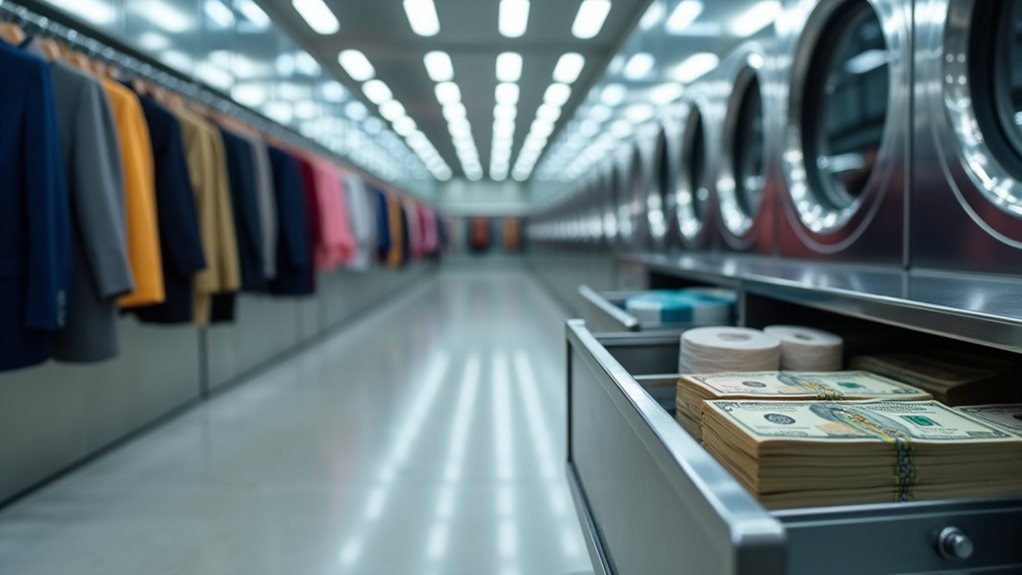
When I first started analyzing dry cleaning businesses, I was surprised to discover that your customer base fundamentally splits into two distinct groups—individual customers who drop off their work clothes and special occasion outfits, and business clients like hotels, restaurants, and corporate accounts that need regular, bulk services.
You’ll find that individual customers typically visit your shop 1 to 4 times monthly, spending anywhere from $20 to $50 per visit, while business clients often establish contracts for consistent, higher-volume orders that can greatly boost your revenue stream.
The beauty of understanding these patterns lies in recognizing that each individual customer can contribute between $240 to $2,400 annually to your bottom line, with the average hovering around $1,000 to $1,200 per year—numbers that’ll make you appreciate every single person who walks through your door! 💰
Understanding these spending patterns becomes even more valuable when you consider that pricing factors like garment type, fabric complexity, and special treatments can significantly impact your per-transaction revenue from both customer segments.
Individual Vs Business Clients
Understanding your customer base isn’t just about counting transactions—it’s about recognizing two fundamentally different worlds that’ll shape your dry cleaning business’s entire financial environment.
Individual clients bring steady, smaller transactions, spending $20-50 per visit with average annual contributions reaching $1,000-1,200. They’re like your reliable morning coffee—consistent but modest.
Business clients, however, represent the financial heavy-hitters, averaging $240-2,400 yearly depending on their operational needs.
Here’s where it gets interesting: while individuals visit 1-4 times monthly with varying average spending per visit, corporate accounts offer something golden—predictable revenue streams through subscription packages.
Smart owners know that balancing both segments creates stability, using business contracts for guaranteed income while nurturing individual relationships for customer retention and community presence.
Dry cleaners located in affluent areas or those serving upscale business districts often see higher per-transaction values from both customer segments, directly impacting the owner’s potential to reach the upper end of the typical $40,000 to $70,000 annual income range.
Visit Frequency and Spending
Although the numbers might seem straightforward on paper, diving deep into visit frequency and spending patterns reveals the heartbeat of your dry cleaning operation—and trust me, it’s more fascinating than watching paint dry (which, coincidentally, is about as exciting as I used to think customer data analysis was 😅).
Understanding customer demographics transforms how dry cleaning businesses approach revenue optimization. Your typical customers create predictable patterns that’ll become your financial foundation:
- Visit frequency ranges from 1-4 times monthly, with regulars forming your bread-and-butter clientele.
- Average spending per visit spans $20-50, depending on service complexity and garment types.
- Annual expenditure reaches $240-2,400 per customer, averaging around $1,000-1,200 yearly.
These patterns directly impact your monthly revenue potential, which varies dramatically from $2,000 in smaller markets to $30,000 in upscale metropolitan areas, making location and customer targeting absolutely essential. Many successful operations diversify beyond basic cleaning by adding specialty services like alterations and leather cleaning to increase revenue per customer visit.
Annual Revenue per Client
Because your dry cleaning business thrives on repeat customers rather than one-time visitors, segmenting your clientele by annual spending patterns becomes the strategic compass that’ll guide your pricing decisions, service offerings, and growth projections.
You’ll discover that customer expenditure creates distinct tiers: occasional users spending $240-400 annually, regular customers contributing $1000-1200, and premium clients reaching $2400 yearly on dry cleaning services.
These spending patterns directly correlate with visit frequency—your bread-and-butter regulars typically come 2-4 times monthly, while occasional visitors might only appear seasonally.
If you’re operating in urban areas, expect higher average annual contribution rates since professionals often require frequent suit maintenance, specialty garment care, and premium services that boost your annual revenue per client substantially.
Understanding these customer segments helps optimize your revenue potential, especially considering that geographic location significantly impacts pricing structures, with urban dry cleaning businesses typically charging 20-40% more than their suburban or rural counterparts.
Monthly and Annual Revenue Projections by Location Type

Your location choice will make or break your dry cleaning dreams, and I learned this the hard way when I watched my friend’s small-town shop struggle to hit $2,000 monthly while urban competitors easily pulled in $10,000.
The harsh reality is that small town revenue often feels like you’re squeezing water from a stone, with limited foot traffic and customers who might drive 20 miles to save five bucks on alterations.
But don’t let that discourage you completely—urban locations bring their own challenges like sky-high rent and fierce competition, though the revenue potential can justify those headaches if you’re strategic about your approach 💭.
Established businesses in affluent neighborhoods often see the best financial performance due to their consistent customer bases and ability to command premium pricing for quality services.
Small Town Revenue
When you’re considering a dry cleaning venture in a small town, the revenue terrain looks quite different from what you’d expect in bustling metropolitan areas, and honestly, it took me years to appreciate the unique charm and challenges of small-town business dynamics.
Your average monthly revenues will likely hover around $2,000, translating to roughly $24,000 annually – not exactly champagne money, but it’s a foundation you can build upon.
Here’s what shapes your small town revenue picture:
- Customer expenditure patterns: Expect $20-$50 per visit with folks returning 1-4 times monthly.
- Operating costs: Lower rent but higher per-unit expenses can squeeze profit margins (10-25%).
- Stable income potential: Consistent relationships create predictable cash flow despite limited population.
Small towns typically offer the advantage of lower operational costs compared to metropolitan areas like Sydney and Melbourne, where dry cleaning prices are generally higher across all service categories.
Building trust becomes your secret weapon!
Urban Location Earnings
While small-town dry cleaning certainly has its merits, urban locations present a remarkably different revenue environment that honestly made my jaw drop when I first researched the numbers – we’re talking about monthly revenues averaging around $10,000, which translates to a much more comfortable $120,000 annually.
But here’s where it gets really exciting: in high-end metropolitan areas, your dry cleaning business makes considerably more through urban location earnings that can reach $30,000 monthly, pushing annual revenue projections up to $360,000.
This boost comes from customers spending $20-$50 per visit, visiting multiple times monthly, plus diverse service offerings that command higher pricing than you’d ever see in smaller markets.
These urban revenue opportunities exist within an industry that employs hundreds of thousands of workers across cleaning facilities, retail locations, and mobile services nationwide.
Operating Expenses and Cost Management Strategies
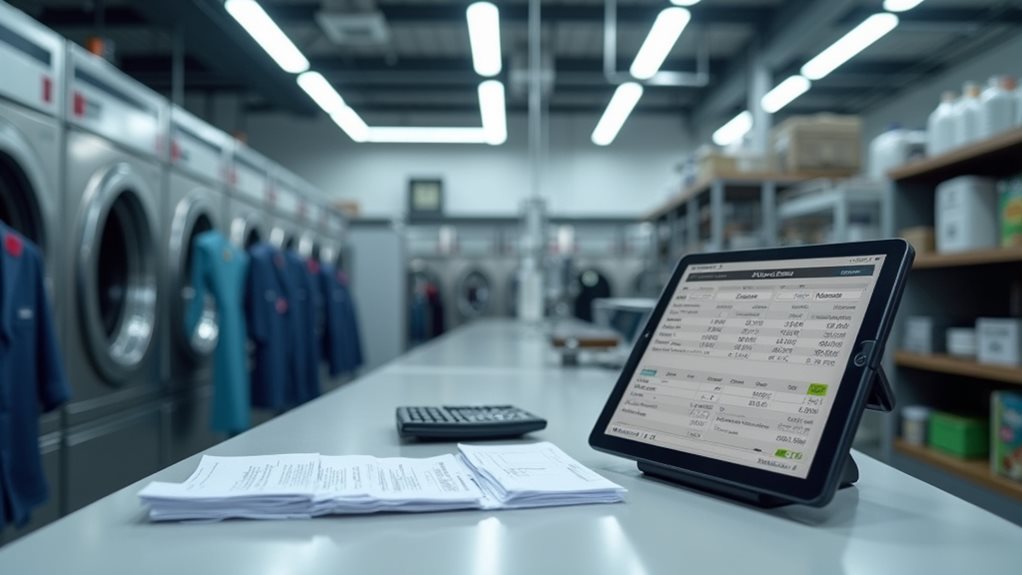
Running a dry cleaning business feels a bit like juggling flaming torches while riding a unicycle – you’ve got multiple expenses flying at you from every direction, and if you drop just one, your whole profit margin can go up in smoke 🔥.
Your major operating expenses include chemical solvents, equipment maintenance, rent, staff wages, and utilities, which directly impact your business valuation and profitability.
Smart cost management becomes your lifeline when gross margins hover between 30-50% and net margins squeeze down to 10-25%.
Here’s your survival toolkit:
- Negotiate ruthlessly with vendors – every dollar saved flows straight to your bottom line
- Monitor utility costs obsessively – those pressing machines are energy vampires
- Streamline operations religiously – efficiency kills waste
Successful dry cleaning operations can achieve profit margins between 15-25% annually when these cost management strategies are properly implemented.

🧹【Package Included】The package contains 1 pcs dusting coffee grinder brush,the size is about 13cm × 1cm,can meet your daily use.

TRUSTED BY PROS & AMATEURS - The Grooveit MiniG Golf Club Cleaning Brush, a favorite among professionals and recreational players, is your mini scrubber for pristine clubs. It's the essential golf club cleaning kit accessory, combining efficiency, compactness, and the perfect addition to your golf accessories bag.
Profit Margins and Breakeven Analysis

Although most dry cleaning owners enter the business dreaming of steady profits, the harsh reality of margins will either make you a master of numbers or send you scrambling back to your day job faster than you can say “perc solvent.”
Your gross margins – that sweet spot between what you charge and your direct costs – typically hover between 30-50%, which sounds decent until you realize that every steam leak, chemical spill, and equipment hiccup starts gnawing away at those percentages like termites in your financial foundation.
Here’s where breakeven analysis becomes your best friend: you’ll need roughly 2,000 pieces monthly to cover $10,000 in fixed expenses.
High profitability demands effective business management, transforming average annual contribution per customer ($1,000-$1,200) into sustainable monthly earnings.
While these gross margins sound promising, your actual profit margins typically settle between 15-25% after accounting for all operational expenses, equipment costs, and labor.

PREMIUM BUILD: Crafted from high-quality materials, our Steam Iron boasts a simple and beautiful shape, ensuring sturdiness and durability for long-lasting use.
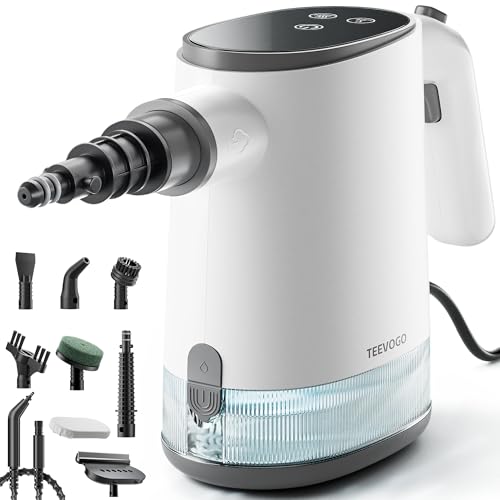
steam mop floor vacuum kitchen appliances home and kitchen house warming gifts new home cleaning supplie grout cleaner kitchen must have bathroom shower all purpose kitchen gifts
Owner Earnings Potential and Success Factors
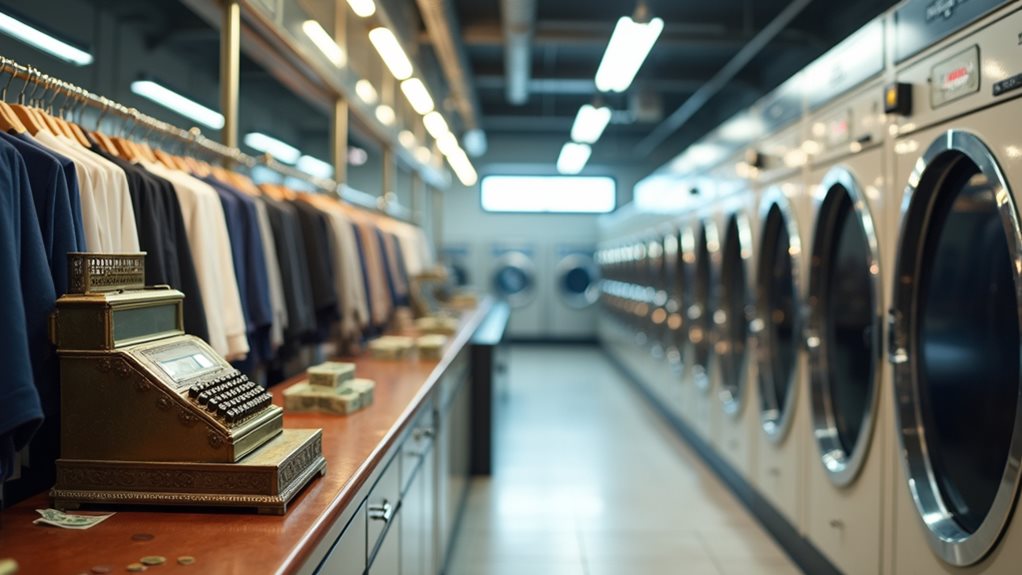
Understanding your breakeven point sets the stage perfectly for grasping what you can actually pocket as a dry cleaning owner, and trust me, the earnings spectrum is wider than the gap between my first disastrous attempt at pressing silk and my current moderately competent wrinkle-removal skills.
Your owner earnings potential hinges on three critical success factors:
- Location and customer loyalty – Prime spots with repeat customers can push monthly earnings from $3,000 to $50,000+ for exceptional performers.
- Service diversification – Expanding beyond basic cleaning improves your profit margins (typically 10-25%) and cash flow sustainability.
- Business model efficiency – Franchise owners often see superior performance with Average Unit Volumes exceeding $1.1 million annually.
With average annual cash flow around $130,000, your success ultimately depends on operational excellence and strategic positioning.